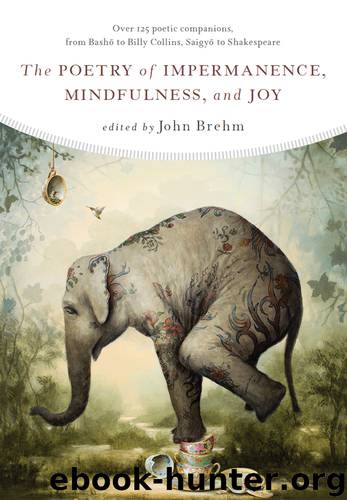
The Poetry of Impermanence, Mindfulness, and Joy by John Brehm
Author:John Brehm
Language: eng
Format: epub
Publisher: Wisdom Publications
Meditation on Sounds
One practice that can deepen mindful reading of poetry is meditating on sounds. Because sound is such a vital aspect of poetry, meditation that heightens our awareness of sound can help us hear poems with greater openness and sensitivity. A number of poems in the anthology are explicitly about sound, listening, or silence: William Stafford’s “Listening,” Dick Allen’s “Listening Deeply,” Denise Levertov’s “Aware,” D. H. Lawrence’s “The White Horse,” Anna Swir’s “Our Two Silences,” Wei Ying-Wu’s “In the Depths of West Mountain, Visiting the Master” and Yosa Buson’s “Coolness.” You may want to read these poems before you begin this meditation, though it is not necessary. If you do read them, just experience them without thinking too much about them.
Choose a length of time for your mediation, set a timer, and place the anthology within easy reach. Once you have settled into your meditation posture, bring your attention to the breath. Simply notice the physical sensations of breathing: the rise and fall of the abdomen, air flowing in and out of the nostrils. Be aware also of whatever body sensations are present: a tingling in the feet, an ache in the low back, a tightness in the jaw, your contact with the cushion or chair. Just notice what’s happening in the body without judging, without trying to push away unpleasant sensations or to prolong pleasant ones.
Now let your awareness expand to include the sounds occurring inside and outside the room. Cultivate a wide open acceptance of whatever sounds appear: cars passing, crows cawing, appliances humming, a neighbor’s lawn mower, sirens in the distance, birdsong, the gurgling of your own stomach. These ambient sounds are sometimes referred to as “the Buddha’s orchestra,” the music of life.
As you sit in meditation, don’t go looking for sounds; just receive without judgment whatever sounds arise. If an unpleasant sound appears, don’t regard it as a disruption or an impediment to your concentration. Turn your attention to it and embrace it with interest and curiosity. Don’t get caught up in identifying or creating a story about the sounds you hear. Instead, notice their impermanent nature, the way they arise, last for a while, and then vanish back into silence. You’ll find that when you listen closely in this way, even sounds that seem more or less constant are changing in subtle ways. See if you can stay with a sound for its entire lifespan: from its appearance, through its changes, to its disappearance. After a while, your sense of a separate listener “in here” and sounds “out there” may fall away: hearing is just happening. If your attention wanders during the meditation, as it surely will, simply acknowledge that by noting “wandering” and return to a spacious awareness of sound.
When you reach the end of the meditation, open the anthology at random and read aloud the first poem you find. Bring the same attention to the poem that you’ve just been bringing to sounds. Close your eyes and see if you can enter the poem without thinking about it.
Download
This site does not store any files on its server. We only index and link to content provided by other sites. Please contact the content providers to delete copyright contents if any and email us, we'll remove relevant links or contents immediately.
Inner Engineering: A Yogi's Guide to Joy by Sadhguru(6800)
The Power of Now: A Guide to Spiritual Enlightenment by Eckhart Tolle(5790)
Fear by Osho(4743)
Ikigai by Héctor García & Francesc Miralles(4279)
The Art of Happiness by The Dalai Lama(4133)
The Ultimate Bodybuilding Cookbook by Kendall Lou Schmidt(3950)
Yoga Therapy by Mark Stephens(3750)
The Little Book of Hygge by Meik Wiking(3698)
The Healing Self by Deepak Chopra(3588)
Why Buddhism is True by Robert Wright(3459)
The Hatha Yoga Pradipika (Translated) by Svatmarama(3352)
Being Aware of Being Aware by Rupert Spira(3283)
Shift into Freedom by Loch Kelly(3203)
Wild Words from Wild Women by Stephens Autumn(3157)
Work Clean by Dan Charnas(3131)
Happiness by Matthieu Ricard(3054)
More Language of Letting Go: 366 New Daily Meditations by Melody Beattie(3034)
Yoga Body & Mind Handbook by Jasmine Tarkeshi(2881)
Why I Am Not a Feminist by Jessa Crispin(2764)
